
aprendIA Northeast Nigeria Pilot: Early Performance Data Shows Promise
17 weeks in, teachers are engaging consistently—and gaining confidence in core pedagogical skills
Back in November, we introduced aprendIA—IRC's AI-driven teacher support program designed to deliver an evidence-based professional development curriculum via WhatsApp. We also shared details about our rigorous red-teaming process to ensure safe deployment in humanitarian contexts.
Now, 17 weeks into our Northeast Nigeria pilot, we have early performance data to share. The results suggest aprendIA is meeting a real need—and doing so in ways that align with how teachers actually work.
Early Pilot Results
As of December 2025, aprendIA reached 642 unique users (teachers) across Northeast Nigeria, generating over 124,000 messages across more than 10,000 learning sessions.
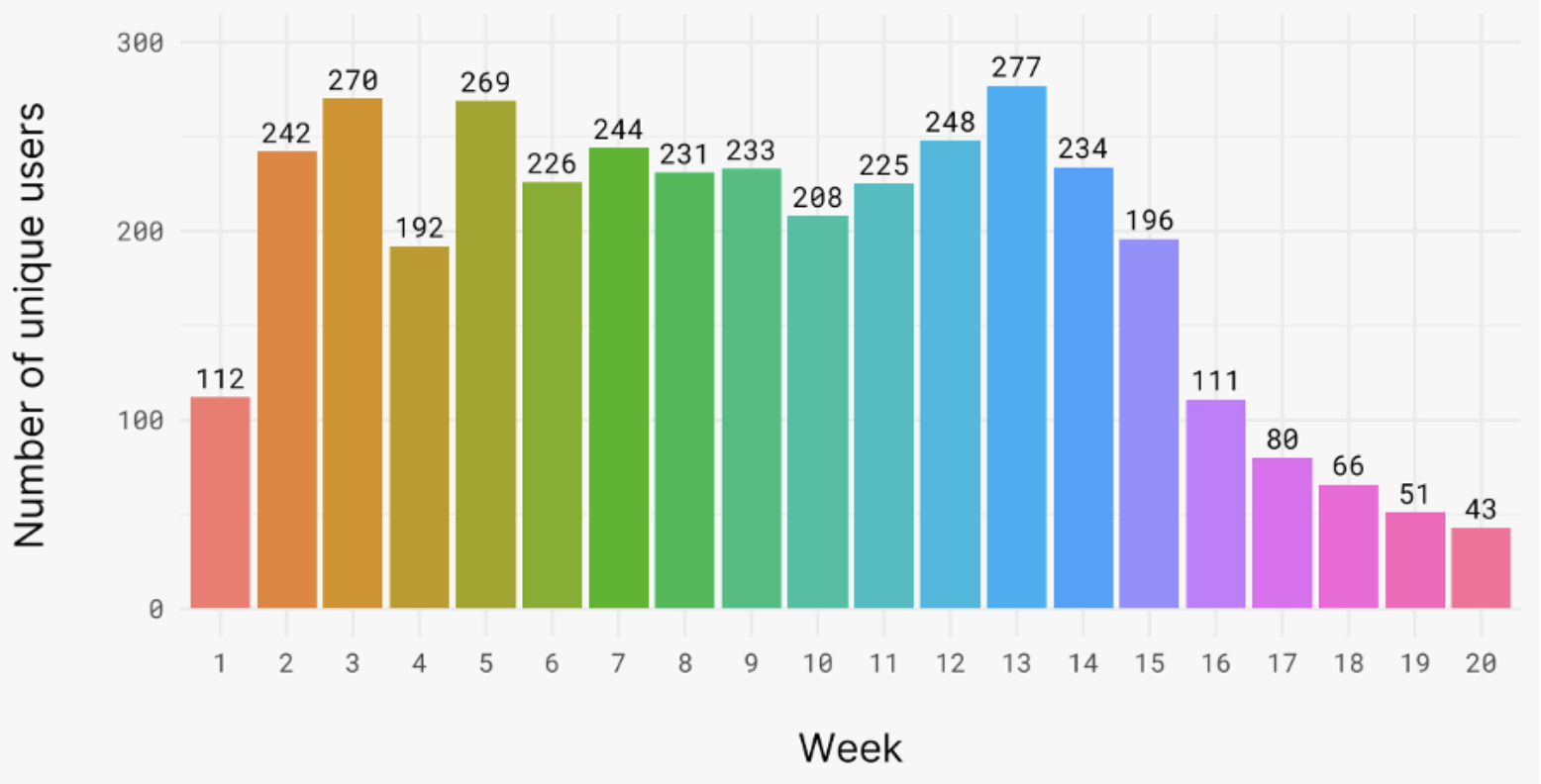
Figure 1: number of unique aprendIA users per week
Usage patterns reveal two distinct engagement windows: 10-11am during school hours (planning periods or breaks) and 7-8pm in the evening (lesson preparation). This isn't random—it shows teachers turning to aprendIA both as a real-time support tool when facing immediate classroom challenges and as a planning resource when preparing tomorrow's lessons.
What Teachers Are Actually Asking About
Analysis of teacher queries reveals the most common challenges they face:
Classroom management dominates, with questions about establishing routines, creating and enforcing classroom rules, and managing large classes: "What's one way to make classroom rules together?" "Can you suggest a method to use in a large class when teaching the English language?"
Managing student attention is another major theme, particularly around transitions and refocusing after breaks: "How can I calm the class after break?" "What's a quick game to re-focus students?"
Subject-specific teaching strategies round out the top queries, with teachers seeking concrete methods for teaching reading and mathematics: "How can I solve subtraction with a new method?" "By pointing the word as you read, then ask questions like where do we start reading?"
Notably, both highly engaged teachers and those with lighter usage ask similar types of questions—indicating aprendIA is meeting real, practical needs across the board.
Measured Improvements in Teacher Confidence
We conducted a matched-pair analysis of 224 teachers surveyed at baseline (August 2025) and again at endline (December 2025). The results show meaningful confidence gains in precisely the areas aprendIA's training emphasizes:
| Confidence Area | Baseline | Endline | Change |
|---|---|---|---|
| Adapting lessons for different learning needs | 57% | 63% | +5.8 pp |
| Keeping students engaged throughout lesson | 69% | 74% | +5.4 pp |
| Managing a large classroom | 49% | 53% | +4.0 pp |
| Assessing student understanding | 69% | 71% | +1.8 pp |
Interestingly, teachers reported a decline in confidence about "planning curriculum-aligned lessons" (-5.8 pp). Rather than a failure, this likely reflects increased pedagogical awareness—teachers who engage deeply with professional development often recognize complexity they had not previously considered. This could be a positive sign of meaningful learning.
High Teacher Satisfaction and Intent to Continue
Among the 224 matched teachers:
84% would recommend aprendIA to other teachers
85% plan to continue using the chatbot
82% find it useful for lesson preparation
83% believe it helps improve classroom management
82% find content relevant to their teaching
Teachers are enthusiastic in their feedback:
“aprendIA has transformed my teaching experience. My students are learning better, behaving better, and I am more empowered as a teacher.” Samuel Agga Bulama, Borno State, Northeast Nigeria
“Thank you, IRC, for this solution that strongly supports teachers like me, saves my time, and has truly been a transformative tool that improves the quality of education for our children.” Yagana Mustapha, Borno State, Northeast Nigeria
“aprendIA is truly a game changer for educators. It came at the right time to support teachers like me." Hussaina Yuguda, Adamawa State, Northeast Nigeria
Strong Course Engagement
Over 17 weeks, teachers started aprendIA courses more than 1,400 times:
Classroom management: 600+ module starts (most popular)
Mathematics instruction: 300+ module starts
Reading instruction: 300+ module starts
All courses are adapted from the IRC's evidence-based programs—Healing Classrooms and Learning to Read & Learning Math in a Healing Classroom—and infused with proven pedagogical approaches like Universal Design for Learning and Learning through Play (LtP).
Course completion indicates learning through three mechanisms: (1) exposure to evidence-based content, (2) practice through structured activities, and (3) retrieval via embedded quizzes. The confidence gains measured in matched pairs validate that course engagement correlates with improved teaching capability.
The Critical Importance of Onboarding
One finding stands out for scale-up: formal onboarding matters enormously.
Formal registration and training workshops dramatically predict sustained engagement:
61% of all aprendIA users began in the first three weeks when formal registration, training, and orientation were provided
94% of the most engaged teachers participated in early workshops with formal onboarding
Among formally registered users, 38% demonstrate sustained, intensive engagement compared to only 22% of unregistered users
This tells us that while the technology is accessible and user-friendly, to maximize aprendIA’s impact at scale, formal onboarding—including registration workshops, orientation, and integration with support structures like WhatsApp groups—is essential.
What's Next: Scaling Thoughtfully
These early results demonstrate proof of concept: aprendIA can deliver high-quality, evidence-based training to teachers in remote areas where traditional workshops are logistically challenging and expensive. A rigorous impact evaluation is planned for September 2026 to measure effects on teaching practice, student learning outcomes, and cost-effectiveness.
Based on these findings, successful scale-up will require:
Formal onboarding for all teachers—Replicating the Cohort 1 experience (registration workshops, orientation, WhatsApp support groups) that drove 94% of sustained engagement
Integration with existing teacher support systems—Positioning aprendIA as a complement to, not replacement for, in-person professional development
Strategic timing—Launching during academic calendar periods with lower competing demands (avoiding December holidays, exam periods)
Continuous improvement—Using usage data to refine content, improve first-day experience, and develop targeted re-engagement strategies
Early Promise, Rigorous Evaluation Ahead
These 17 weeks validate the core hypothesis: teachers in crisis-affected contexts need and will use accessible, evidence-based professional development opportunities that meet them where they are—both technologically and pedagogically.
The combination of meaningful confidence gains, high teacher satisfaction, strong course engagement, and usage patterns that reflect genuine integration into teaching routines suggests aprendIA is on the right track. But we remain committed to rigorous evaluation. The September 2026 impact study will provide the evidence needed to understand not just whether teachers use aprendIA, but whether it meaningfully improves teaching practice and, ultimately, student learning outcomes.
For now, the data from Northeast Nigeria shows that when you combine accessible technology, evidence-based content, thoughtful design, and proper onboarding, teachers respond—and their confidence in core pedagogical skills grows.
aprendIA is developed by the International Rescue Committee and powered by the Signpost AI orchestration system. For more information, visit aprendIA.io