
InfoDigna: How IRC Mexico Is Using AI to Expand Reach Without Compromising Safety
By Signpost HQ & Luis Alberto Tejeda Carrasco, Senior Signpost Officer
Mexico is home to one of the most complex human mobility landscapes in the world. Deportees, refugees, asylum seekers, migrants in transit, and internally displaced people — many of them fleeing armed conflict, violence or human rights abuses — arrive in vulnerable circumstances. For these populations, access to accurate, timely information about their rights, available services, and legal procedures is not a convenience. It can be lifesaving.
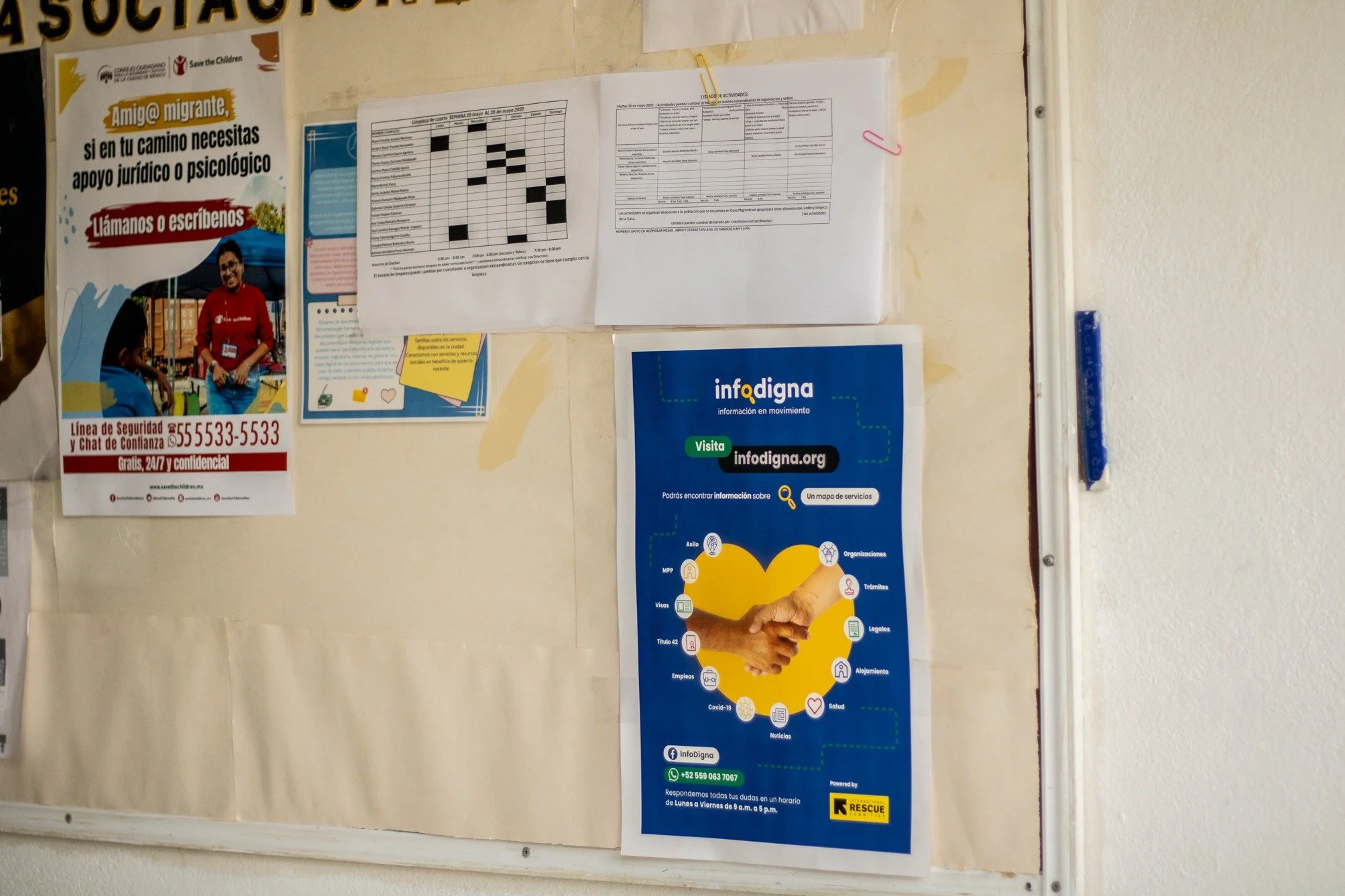
In 2021, the International Rescue Committee (IRC) Mexico responded to this need by launching InfoDigna, a digital humanitarian information project developed in collaboration with Signpost. InfoDigna provides safe, reliable, and accessible information to anyone navigating human mobility in Mexico, regardless of nationality or immigration status. Users reach the platform through WhatsApp, Facebook, Instagram, email, or the InfoDigna website, and receive a response — through a ticket-based system staffed by a dedicated team — in under six hours on average. To date, InfoDigna has supported over 20,000 people, with a 95% satisfaction rate.
The Challenge: Scaling Personalized Support
For a small team fielding between 50 and 300 new messages each week, capacity has always been a constraint. The questions InfoDigna receives may seem straightforward — how do I access health services? What is the asylum or refugee process? Where can I find shelter? — but answering them well requires precision and deep contextual knowledge. An incomplete or inaccurate response is not just unhelpful; in situations this high-stakes, it can cause real harm.
Generative AI offered a compelling opportunity to expand InfoDigna's reach. But deploying it responsibly demanded careful design across several dimensions: what knowledge the system would draw from, how it would communicate with users, how responses would be tested, and — critically — when a human would need to step in.
Building a Safe and Reliable System
A trusted knowledge base
The foundation of InfoDigna's AI model is a curated knowledge base built from IRC's own expertise. This includes a library of original self-help and informative articles addressing the most common challenges faced by InfoDigna users, information on roughly 200 services provided by IRC, government offices and partner organizations across 15 Mexican cities, and a set of whitelisted external websites with verified, up-to-date information. The team developed a clear protocol for determining which external sources meet the standard for inclusion — an important safeguard in an information environment where accuracy is non-negotiable.
Design centered on trust and accessibility
InfoDigna's AI responses were integrated into the communication channels users already relied on, avoiding any need to download new tools or navigate unfamiliar platforms. The team deliberately set a warm, empathetic tone for responses — one that feels like hearing from a caseworker rather than a system. They also made a principled choice to minimize data collection, avoiding login requirements and unnecessary data storage in order to reduce barriers and build user trust.
Rigorous testing before deployment
Testing followed two distinct phases. The first was a qualitative evaluation of response quality, with both engineers and field staff assessing accuracy, reliability, and currency of information across more than 30 of the most frequently asked topic areas. The second phase was a red-teaming exercise focused on the integrity of the model — ensuring it stayed within its intended scope and could not be steered into producing harmful or off-mission outputs.
Where InfoDigna Is Breaking New Ground: Automated Escalations
Perhaps the most significant innovation in the InfoDigna model is its automated escalation system, which identifies high-risk situations and routes them to a human moderator.
Given that InfoDigna's users include people experiencing violence, acute mental health crises, or urgent protection needs, the team recognized early that AI alone could never be sufficient. A human-in-the-loop approach is central to IRC's "do no harm" commitment.
The escalation protocol defines clear criteria for what constitutes a high-risk case and ensures that any user who simply prefers to speak with a person — rather than a chatbot — can request that transfer at any time. The system is currently being tested through structured simulations: an anonymous database of real user inquiries is used to generate test scenarios that evaluate whether the model correctly identifies risk levels and escalates appropriately under a hybrid human-AI assistance model.
What Comes Next
InfoDigna's AI model is currently in active testing. The decisions made so far — on knowledge sourcing, tone, data minimization, and escalation — reflect a deliberate and principled approach to integration, but the real measure of success will come from the evidence.
In the coming months, Signpost and IRC Mexico will publish two follow-up reports:
The first will share the findings from the testing phase: what the structured simulations revealed about the model's accuracy, its ability to identify high-risk cases, and any adjustments made as a result.
The second will report on the live pilot, documenting how the system performs in real-world conditions and what it means for both the people InfoDigna serves and humanitarian staff itself.
We'll be sharing both reports here. If you're working on similar questions around AI in humanitarian response and want to exchange notes in the meantime, we'd love to hear from you.
